



THE CROWN KNOWLEDGE LIBRARY
Crownology
Your Complete Crown Care & Construction Guide
Find your fit, understand your crown and care for it with confidence.
Explore Crownology
Measure for Your Crown
A comfortable crown begins with the right fit. Use a flexible measuring tape over your hair as you intend to wear it beneath your crown. Record your circumference, ear-to-ear measurement and front-to-nape measurement.
Compare all three measurements with the specific designer’s chart for your chosen style. Petite, average and large are not universal across brands. If you fall between sizes, ask a Crown Consultant for guidance before ordering.
Traditional vs Heat-Friendly Synthetic
Traditional synthetic fibers retain their factory-set style and are usually cared for without heated styling tools. Do not apply heat unless the manufacturer explicitly permits it for that fiber.
Heat-friendly synthetic fibers allow controlled heat styling within the manufacturer’s instructions. Heat-friendly does not mean heat-proof: use the specified tool, temperature and technique, and detangle gently to limit friction and tangling.
Human Hair vs Synthetic
Synthetic crowns generally offer convenient, pre-set styling. Their care needs and styling limits depend on whether the fiber is traditional or heat-friendly.
Human-hair crowns offer styling flexibility but need more hands-on care and restyling after washing. Processing, cap construction, hair length and daily wear all affect maintenance. Choose according to the time you want to spend styling, your preferred look and the exact product’s care instructions.
Understanding Hair Colors
Use the designer’s exact color code and color name when choosing your shade. Codes and shade names do not necessarily match across brands.
Rooted or shaded colors have a contrasting root area; highlighted shades combine lighter strands with a base; blended shades mix several tones. Photographs, screens, indoor lighting and daylight can change how a color appears. Compare references for the same brand and fiber, and request guidance if you are unsure.
Lace Front & Monofilament
Lace front describes the sheer lace section along the front hairline. Monofilament describes a fine mesh section where hairs are individually tied to create a scalp-like appearance.
A monofilament section may cover the full top, a center or side part, or a smaller crown area. These features can be combined with either a wefted back or a hand-tied base. A double-monofilament top has an additional layer; it does not mean the whole cap is hand-tied.
Hair Toppers & Hairpieces
A topper adds coverage or fullness to a selected area and blends with your own hair. A full wig covers a larger area, while hairpieces can add volume or styling detail in a specific place.
Compare the coverage area, base shape and dimensions, fiber, attachment method, length and color. Clip-in pieces require suitable surrounding hair for secure attachment. Ask for fitting advice if you are unsure which base or attachment suits your needs.
Measure for a Topper
Arrange your hair as you usually wear it, then identify the area you want to cover. Measure its front-to-back length and side-to-side width.
For a clip-in topper, the base must extend beyond the coverage area so its clips can attach to suitable hair. Do not choose a base that is too small simply to match the thinning area. Check the base dimensions and attachment layout for the specific piece, and ask for assistance where needed.
Washing & Conditioning
Begin by identifying the fiber and reading the designer’s care directions. Gently detangle before washing, use approved products and the prescribed water temperature, and handle the hair without scrubbing or bunching it.
Rinse gently, blot excess moisture with a towel and follow the recommended drying method. Apply conditioner only where directed; avoid saturating knots, lace or attachment areas unless the product’s instructions allow it. Do not wring the hair. Wash frequency depends on wear, products and the particular crown.
Styling & Heat Safety
Check whether the crown is traditional synthetic, heat-friendly synthetic or human hair before choosing any styling tool. Use only the tools and temperatures approved for that exact fiber.
Protect delicate lace and knots from pulling. Avoid unnecessary heat and friction, and keep the crown away from oven heat, steam and other uncontrolled heat sources. When the fiber’s instructions are unclear, confirm them before styling.
Storage & Travel
Store a clean, dry crown on a suitable stand or in its original packaging, following the designer’s directions. Protect it from dust, direct heat, crushing and friction.
For travel, gently detangle, support the cap shape and pack the crown securely. Keep approved care products and a suitable comb with it. Do not seal a damp crown in a storage bag or box.
Crown Glossary
Lace front
A sheer lace section along the front hairline.
Monofilament
A fine mesh area with individually tied hairs; it may be a full top, part or crown section.
Double monofilament
A monofilament construction with an additional layer for a softer inner surface.
Wefting
Rows of hair sewn to strips that form part of the cap foundation.
Hand-tied
Hairs individually tied into the cap material; check which cap sections use this construction.
Nape
The back-neck area of the cap.
Ear tabs
Side sections near the ears that help position the crown.
Density
The amount or fullness of hair in the piece.
Denier
A measure of fiber fineness or thickness.
Rooted or shaded
A color effect with a different tone near the roots.
Crownology Tutorials
Begin with the measuring guide, then compare fibers, cap features and care needs using the sections on this page.
Planned tutorial topics include measuring your head, understanding lace fronts and monofilament sections, washing and air-drying a synthetic crown, selecting a shade, and storing a crown for travel. Original tutorial videos can be added here when they are available.
Illustrated Wig Cap Comparison
Explore 20 cap images and construction views, with consistent photo dimensions, corrected descriptions and Bella Princess watermarks. Look at the top, hairline, sides and back together: a single cap can combine several construction features.

Lace Front Cap
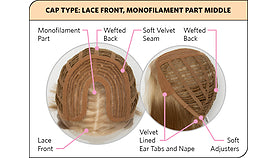
Center-Part Monofilament
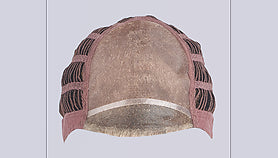
Side-Part Monofilament
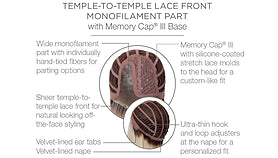
Lace Front · Monofilament Top
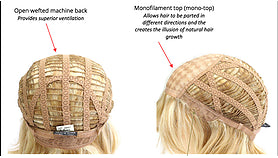
Monofilament Top · Wefted Back

Soft-Lined Monofilament Cap

Monofilament Top · Hand-Tied
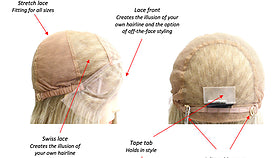
Full Lace · Hand-Tied

French Top · Medical Cap

360° Lace Cap

Basic Machine-Wefted Cap

Lace Front · Monofilament Top
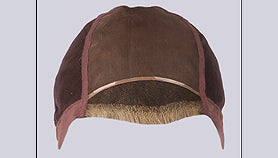
Lace Front · Hand-Tied Base

Extended Lace Front · Hand-Tied

Lace Front · Monofilament Detail

Lace Front · Hand-Tied Detail

Hand-Tied Base · Side View
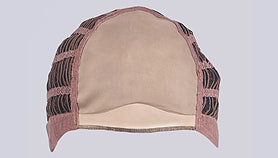
Double Monofilament · Front View

Hand-Tied · Silicone Nape
How to Measure for Your Crown
Use a soft tape and keep it snug, not tight. Measure over your natural hair as you plan to wear it under the crown.
- Circumference: follow the front hairline, pass behind each ear and around the nape, then return to the start.
- Ear to ear: measure over the top of the head from one side hairline above the ear to the other.
- Front to nape: measure from the center front hairline over the crown to the nape of your neck.
Record all three measurements and compare them with your chosen designer’s chart. The illustration’s size references are general guidance, not a universal fitting chart.
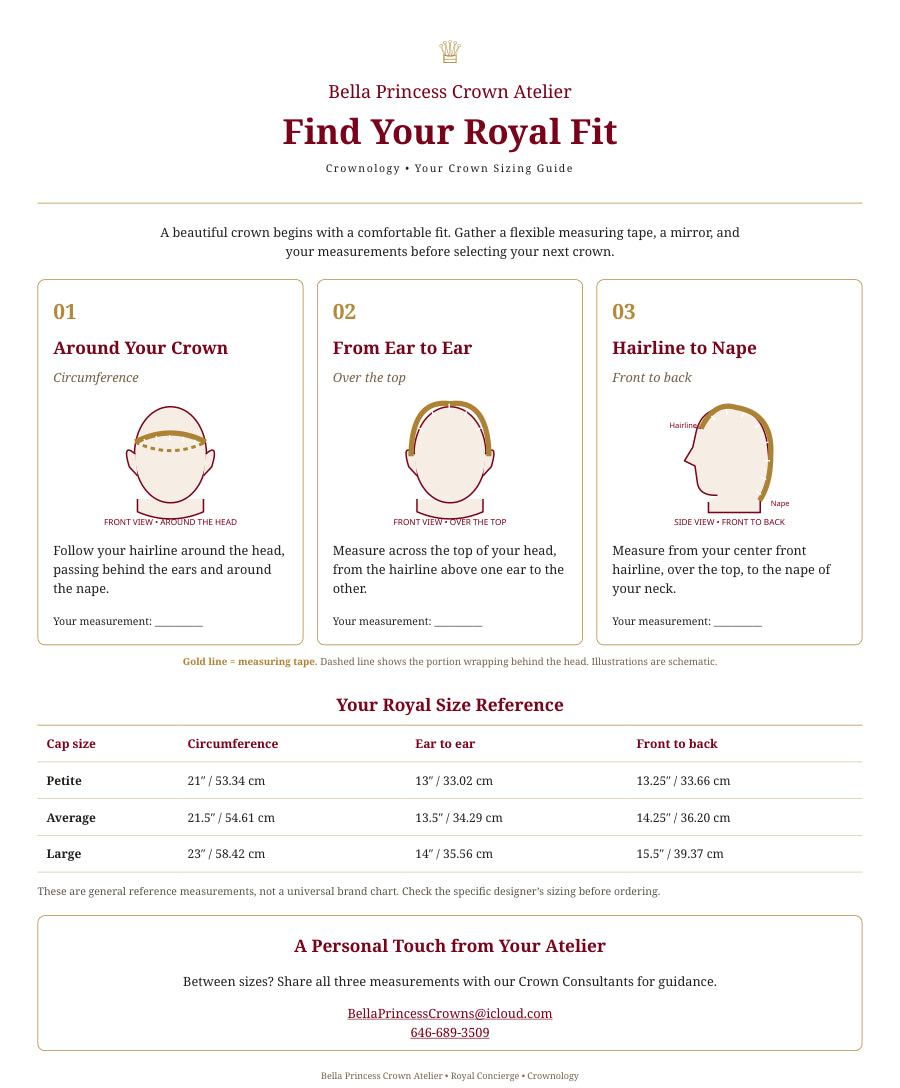
Royal Size Reference
| Cap size | Circumference | Ear to ear | Front to back |
|---|---|---|---|
| Petite | 21 in / 53.34 cm | 13 in / 33.02 cm | 13.25 in / 33.66 cm |
| Average | 21.5 in / 54.61 cm | 13.5 in / 34.29 cm | 14.25 in / 36.20 cm |
| Large | 23 in / 58.42 cm | 14 in / 35.56 cm | 15.5 in / 39.37 cm |
These are general reference measurements, not a universal brand chart. Always check specific designer sizing.
Washing & Care by Hair Fiber
Traditional synthetic: gently detangle, wash with approved synthetic-fiber products in the recommended water temperature, rinse without rubbing, blot and air-dry as directed. Avoid heated tools unless expressly approved.
Heat-friendly synthetic: use fiber-approved care products and follow the exact heat limits and styling directions. Detangle carefully, particularly at the nape, and reduce unnecessary friction.
Human hair: use products suitable for the hair’s processing and cap construction. Detangle gently, wash without tangling, condition as directed and use appropriate heat protection when styling is permitted.
Every crown: follow its designer’s instructions first. Avoid scrubbing, twisting or wringing, and confirm that products are compatible with the fiber and cap.
A Personal Touch from Your Atelier
BellaPrincessCrowns@icloud.com · 646-689-3509